

How does a refinery refining machine handle impurities in raw materials?
Aug 06, 2025
Leave a message
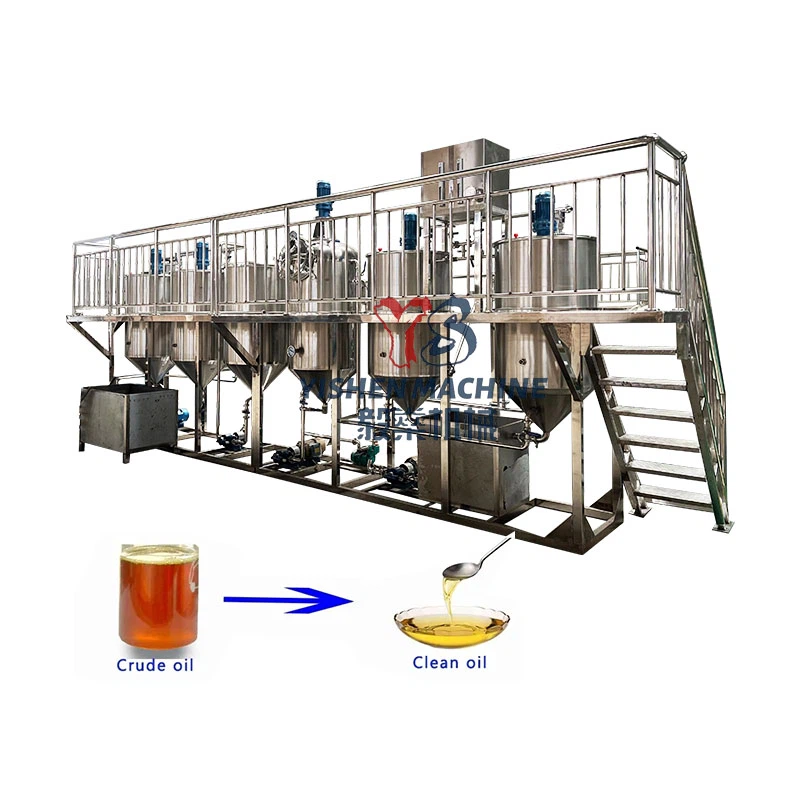
As a reputable supplier of refinery refining machines, I've witnessed firsthand the critical role these machines play in transforming raw materials into high - quality refined products. In this blog, I'll delve into the intricate process of how our refinery refining machines handle impurities in raw materials.
Understanding the Nature of Impurities in Raw Materials
Before we discuss how our machines deal with impurities, it's essential to understand what these impurities are. Raw materials, whether they are crude oil, vegetable oils, or other substances, often contain a variety of unwanted components. For instance, in crude oil, impurities can include water, salts, solids such as sand and clay, and various organic compounds like sulfur - containing molecules. In vegetable oils, impurities may consist of free fatty acids, phospholipids, pigments, and odor - causing substances.
These impurities can have a significant impact on the quality and usability of the final product. They can cause corrosion in processing equipment, reduce the efficiency of subsequent processes, and affect the taste, color, and stability of the refined product. Therefore, removing these impurities is a crucial step in the refining process.
Initial Screening and Separation
The first stage in handling impurities is usually a preliminary screening and separation process. Our refinery refining machines are equipped with advanced filtration systems that can remove large - sized solid particles from the raw materials. For example, in the case of palm oil, the raw palm oil may contain fibrous materials and other debris. Our Palm Oil Refinery Machine uses mechanical filters to separate these large particles at the very beginning of the refining process.
This initial step not only protects the downstream equipment from damage but also reduces the load on the subsequent purification processes. The filters can be easily cleaned or replaced, ensuring continuous and efficient operation of the machine.
Removal of Water and Salts
Water and salts are common impurities in many raw materials, especially in crude oil. Excess water can cause problems such as corrosion and emulsion formation, while salts can deposit on heat - exchange surfaces, reducing their efficiency.
Our refinery refining machines use a combination of techniques to remove water and salts. One of the most common methods is desalting, which involves mixing the raw material with fresh water and then separating the water phase containing the dissolved salts. This process is often accompanied by the application of electrical fields to break up emulsions and enhance the separation of water and oil phases.
In addition, our machines are designed with efficient dehydration systems. These systems use techniques such as heating and vacuum distillation to remove the remaining water from the raw material. By carefully controlling the temperature and pressure, we can ensure that the water is removed without causing significant damage to the valuable components in the raw material.
Deacidification
Free fatty acids are a major impurity in vegetable oils. They can cause rancidity and off - flavors in the final product. Our Oil Refinery Machines employ different methods for deacidification, depending on the type of oil and the specific requirements of the customer.
One common method is chemical deacidification, which involves adding an alkaline solution to the oil to react with the free fatty acids and form soap. The soap can then be separated from the oil by sedimentation or centrifugation. Another method is physical deacidification, which uses steam distillation under vacuum conditions to remove the free fatty acids. Physical deacidification is often preferred for high - quality oils as it can preserve more of the natural antioxidants and nutrients in the oil.

Removal of Phospholipids
Phospholipids, also known as gums, are present in many vegetable oils. They can cause cloudiness and instability in the oil. Our refinery refining machines use a process called degumming to remove these phospholipids.
There are two main types of degumming: water degumming and acid degumming. Water degumming involves adding a small amount of water to the oil, which causes the phospholipids to hydrate and form a separate phase that can be removed by centrifugation. Acid degumming is used for oils with high - phosphatide content. In this process, an acid such as phosphoric acid or citric acid is added to the oil to convert the non - hydratable phospholipids into hydratable forms, which can then be removed by water degumming.
Bleaching
Pigments are another type of impurity that can affect the color of the final product. Our machines use a bleaching process to remove these pigments. The bleaching process typically involves mixing the oil with a bleaching earth or activated carbon, which adsorbs the pigments and other impurities.
The bleaching earth or activated carbon has a large surface area and high adsorptive capacity. After the adsorption process, the bleaching agent is separated from the oil by filtration. Our refinery refining machines are designed to ensure efficient mixing and separation during the bleaching process, resulting in a clear and light - colored oil.
Deodorization
Odor - causing substances are often present in raw materials, especially in vegetable oils. These substances can give the oil an unpleasant smell and affect its marketability. Our Coconut Oil Refinery Machine and other machines use a deodorization process to remove these odor - causing compounds.
Deodorization is usually carried out under high - temperature and vacuum conditions. Steam is passed through the oil, which vaporizes the volatile odor - causing substances. These substances are then condensed and removed from the system. The deodorization process not only improves the smell of the oil but also enhances its stability by removing some of the oxidation - prone compounds.
Continuous Monitoring and Quality Control
Throughout the refining process, our refinery refining machines are equipped with advanced monitoring systems. These systems continuously measure various parameters such as temperature, pressure, flow rate, and the concentration of impurities. By closely monitoring these parameters, we can ensure that the refining process is operating at optimal conditions and that the quality of the final product meets the required standards.
In addition, we also conduct regular quality control tests on the refined products. These tests include analyzing the chemical composition, physical properties, and sensory characteristics of the products. Any deviations from the standards can be quickly identified and corrected, ensuring that our customers receive high - quality refined products.
Why Choose Our Refinery Refining Machines?
Our refinery refining machines are designed with the latest technology and highest quality materials. They are highly efficient, reliable, and easy to operate. We offer a wide range of machines to meet the different needs of our customers, whether they are small - scale producers or large - scale industrial manufacturers.
If you are in the market for a refinery refining machine, we invite you to contact us for a detailed discussion. Our team of experts will be happy to provide you with more information about our products, answer your questions, and help you choose the most suitable machine for your specific requirements. Let's work together to achieve the highest level of efficiency and quality in your refining process.
References
- "Handbook of Vegetable Oil Processing" by Fereidoon Shahidi
- "Petroleum Refining Technology and Economics" by James G. Speight