

What are the key components of oil refinery machines?
Dec 15, 2025
Leave a message
Hey there! As a supplier of Oil Refinery Machines, I've had the privilege of diving deep into the world of these incredible pieces of equipment. In this blog, I'm gonna break down the key components of oil refinery machines, so you can get a better understanding of what makes them tick.
1. Distillation Columns
One of the most crucial components of an oil refinery machine is the distillation column. It's like the heart of the operation. You see, crude oil is a complex mixture of different hydrocarbons with varying boiling points. The distillation column takes advantage of this property to separate these hydrocarbons.
The column is a tall, vertical structure with trays or packing inside. Crude oil is heated and vaporized at the bottom of the column. As the vapor rises, it cools down. Different hydrocarbons condense at different heights in the column based on their boiling points. The lighter hydrocarbons, like gasoline and jet fuel, condense near the top, while the heavier ones, such as diesel and lubricating oils, condense lower down.
Think of it as a big sorting machine. It's constantly working to separate the crude oil into more useful products. Without distillation columns, we wouldn't be able to get the high - quality fuels and oils that we rely on every day.
2. Heat Exchangers
Heat exchangers are another vital part of oil refinery machines. Their main job is to transfer heat from one fluid to another. In an oil refinery, there are many processes that require heating or cooling. For example, before the crude oil enters the distillation column, it needs to be heated to a certain temperature. Heat exchangers can use the hot products coming out of other processes to heat the incoming crude oil.
This is a great way to save energy. Instead of using a lot of extra fuel to heat the crude oil, we can reuse the heat that's already in the system. There are different types of heat exchangers, like shell - and - tube heat exchangers and plate heat exchangers. Each type has its own advantages and is used in different situations depending on the flow rates, temperatures, and pressures involved.
3. Reactors
Reactors play a key role in changing the chemical composition of the hydrocarbons in the oil. There are several types of reactions that can happen in an oil refinery. For instance, catalytic cracking reactors are used to break down large hydrocarbon molecules into smaller ones. This is important because smaller molecules are often more valuable. For example, cracking heavy oils into gasoline - range hydrocarbons can increase the production of gasoline.
In these reactors, a catalyst is used to speed up the chemical reaction. The catalyst provides a surface where the hydrocarbon molecules can react more easily. It's like a little helper that makes the reaction happen faster and more efficiently. There are also other types of reactors, like hydrotreating reactors, which are used to remove impurities such as sulfur and nitrogen from the oil. This is important for environmental reasons, as reducing sulfur in fuels helps to cut down on air pollution.
4. Pumps and Compressors
Pumps and compressors are the muscle of the oil refinery machines. Pumps are used to move liquids, like crude oil and refined products, through the pipes in the refinery. They provide the necessary pressure to make sure the fluids flow smoothly from one part of the process to another.
Compressors, on the other hand, are used to compress gases. In an oil refinery, there are many processes that involve gases, such as the separation of light hydrocarbons. Compressors increase the pressure of these gases, which can make them easier to transport and process. Without pumps and compressors, the whole refinery would come to a standstill. The fluids and gases wouldn't be able to move around, and the various processes couldn't take place.
5. Fractionators
Fractionators are similar to distillation columns, but they are used for more precise separation. After the initial distillation in the main column, the products may still be a mixture of different hydrocarbons. Fractionators are used to further separate these mixtures into even more specific fractions.
For example, if we want to produce a very pure grade of gasoline, a fractionator can be used to separate out the exact hydrocarbons that we need. It allows us to fine - tune the quality of the products. Fractionators are often smaller and more specialized than distillation columns, but they are just as important in getting the high - quality products that the market demands.
6. Storage Tanks
Last but not least, storage tanks are an essential part of the oil refinery setup. They are used to store the crude oil when it arrives at the refinery and also to store the refined products before they are shipped out. Storage tanks come in different sizes and shapes, depending on the volume of oil or product that needs to be stored.
These tanks need to be carefully designed and maintained to prevent leaks and ensure the safety of the stored products. They are often equipped with monitoring systems to keep track of the level, temperature, and pressure inside the tank. Without proper storage, the refinery wouldn't be able to operate smoothly. It allows for a buffer between the production and the distribution of the products.
Now, if you're in the market for oil refinery machines, we've got a great range of options. Check out our Soybean Oil Refinery Machine, Coconut Oil Refinery Machine, and Food Oil Refinery Machine. These machines are designed with the latest technology and high - quality components to ensure efficient and reliable operation.

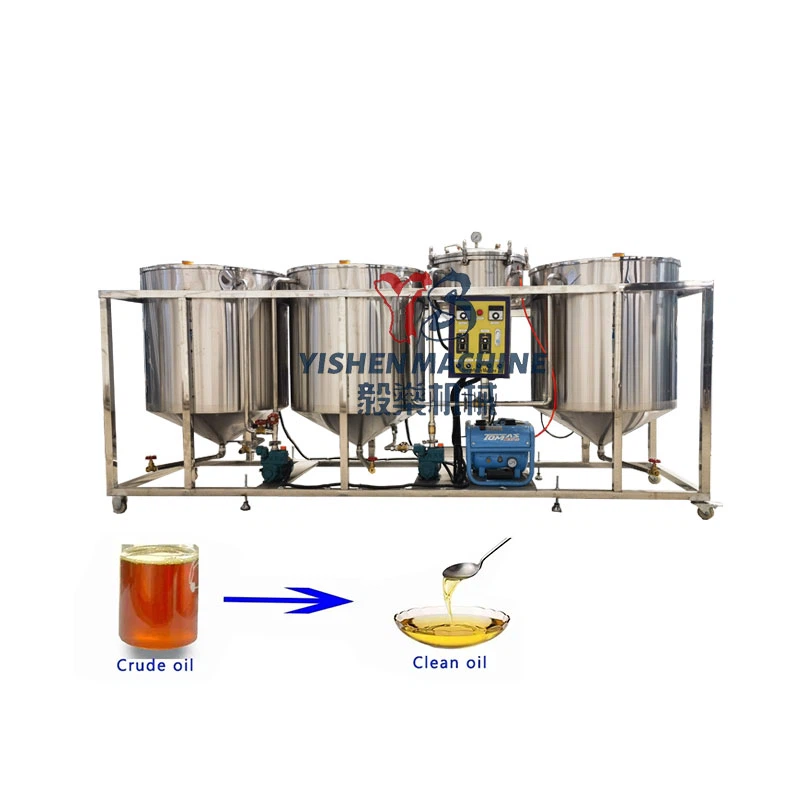
If you're interested in learning more about our products or have any questions about oil refinery machines, don't hesitate to reach out. We're here to help you find the right solution for your needs. Whether you're a small - scale producer or a large - scale refinery, we've got the expertise and the equipment to support you.
References
- "Petroleum Refining Technology and Economics" by James G. Speight
- "Handbook of Petroleum Refining Processes" by Robert A. Meyers